
Overground, Underground, Wombling Free-Roam
In 2003, Need for Speed Underground’s shift away from exotic supercars and towards streetracing culture ended up being a massive hit for EA, and they quickly got Black Box to work on a sequel. Just one year later would see the release of Need for Speed Underground 2, a game that doubled down on everything that made the first game popular: more customisation, more event types, more cars with more diversity, and most notably – a fully open map for players to explore.

The game opens with a comic book style cutscene (gone are the uncanny animations from the previous game) showing the player being betrayed and moving to the city of Bay View. It’s a direct sequel to the last game, but just like Underground, the story here is just an excuse to get you in a car and racing.
There are 29 vehicles to choose from this time around, 9 more than Underground’s count, and two more can be unlocked by cheat code. The car selection is once again a range of fairly attainable cars. You’ll start in one of six cars that you could have very well been driving yourself back in 2004, like the Ford Focus, Mazda MX5, or Vauxhall Corsa. The most expensive car in the game is the Nissan Skyline GT-R (R34) which would have sold new in the UK for about £54,000 – so even the higher end vehicles here aren’t necessarily out of reach for the aspiring real world enthusiast.

The game has a pretty satisfying progression system with players starting out with a small portion of the city to explore and race in, with other parts of the city being gradually unlocked as you fulfil criteria issued by sponsors. You get to choose which sponsor you partner with each time, with their requirements all being similar, but normally favouring a specific event type – so it gives some player agency to which events you’d prefer to tackle.
Speaking of events, the event type count has increased from five, to eight. Circuit, sprint, drag, drift, and lap knockout all return from Underground, but Street X (circuit races on small, technical tracks,) URL (circuit championships that take place on closed off racetracks,) and SUV exclusive events are all new. There’s also open world exclusive events: outrun races that challenge you to overtake and get a certain distance away from rival racers, and timed point to point missions that call upon your knowledge of the road layout to reach key locations on the map without the use of your GPS.
Notes on Completion
I completed the main story mode winning every event presented to me. I didn’t seek out all the hidden events however so didn’t achieve 100% completion.
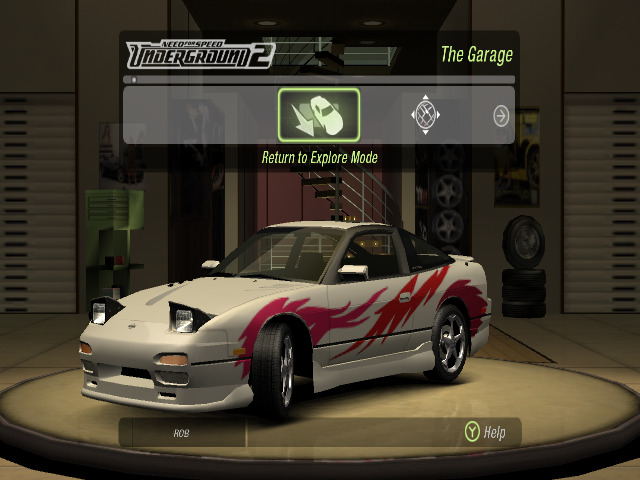
Customisation plays a much larger role this time around, with progression being gated behind the visual rating of your car – on a scale of 1-10. There’s a massive array of visual customisation options too, ranging from the standard array of body kits, spoilers, roof scoops, hoods, rims, and exhausts; but Underground 2 goes much, much further than any other game in the series, also offering options for headlights, taillights, side mirrors, neon, window tints, headlight colours, nitrous purges, hydraulics, doors, split hoods, spinner rims, and even the audio setup in your trunk. It’s a staggering array of options, my issue with the system is that because progression is gated behind it, you’re essentially forced to add one of everything to a vehicle in order to get through the game. I couldn’t bring myself to ruin my Corolla with some of the more gaudy customisation options, so I had to buy a second car just to riddle with ugly, ridiculous cosmetics.

The game’s also much easier than its predecessor. For me that’s a huge positive as I really struggled with Underground at times. Although I do think that the improved arcade-style handling coupled with the easier difficulty does trivialise the game somewhat. It’s a fun ride, but I’d be hard-pressed to call it challenging.
Overall, I think it’s an improvement to Underground. It looks better, sounds better, the soundtrack is more diverse, pretty much everything is bigger and better. I know some people prefer the simplicity of the first game, citing the open world in the sequel as superfluous. And while that’s true – there’s not a whole lot to do in the open world, this was back when it was novel to just be able to drive around and explore, and the city of Bay View is to this day is well designed enough that it is fun to just cruise around. Any criticisms I have are minor, and I can solidly recommend this game to anyone in 2026.
| Pros | Cons |
| Graphically impressive | Difficulty might be a little too easy |
| Killer soundtrack | Progression tied to customisation can be frustrating |
| More cars, more events, more of everything | Can get annoying having to drive across the map to every event |
Leave a Reply